Research
With a group at Johns Hopkins, I study how frozen language models handle time and memory.

Preprints
Constrained Diffusion for Data-Scarce Orbital Monte Carlo in Constellation Tasking
O. Ramadan, S. Siavoshian, A. K. Saeed, B. A. Johnson, A. M. E.-A. Diab, B. M. Rodriguez
arXiv:2610.09323 [astro-ph.IM] · October 2026 · Under review, IEEE Aerospace Conference 2027
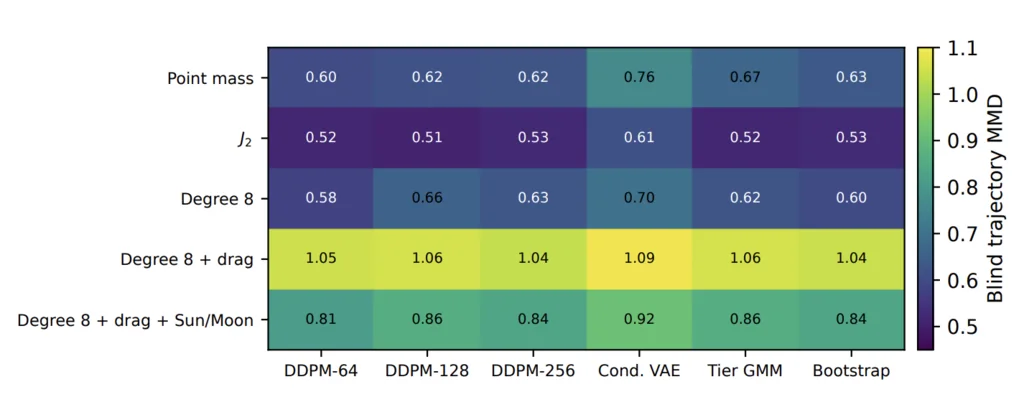
Constellation Monte Carlo results depend on the orbital population used to evaluate a tasking policy. With scarce reference trajectories, replay limits geometric diversity, while independent orbital-element jitter can violate physical constraints. We study constrained diffusion for orbital-population augmentation. A force-conditioned diffusion model learns a 13-dimensional orbital prior, recovering semimajor axis from perigee altitude and eccentricity; Basilisk propagates each sample under one of five force-model tiers. Using 800 reference trajectories, we compare diffusion with jittered bootstrap, per-tier Gaussian mixtures, and a conditional variational autoencoder, and evaluate distributional fidelity, support shift, classical astrodynamics diagnostics, and 4,000 paired GoDSAT-compatible campaigns. The largest diffusion model achieves held-out trajectory MMD of 0.0171 ± 0.0239, similar to bootstrap (0.0170) and the mixture (0.0198), but samples farther from training priors (median nearest-training distance 2.7 versus 0.10 standardized units). All generators fail to match the shifted-blind population (classifier AUC 0.991–0.998). Endpoint-conditioned samples satisfy Lambert boundaries but have greater interior error than the matched Lambert reference (29.2 versus 5.7 km mean RMSE). Residual diffusion improves selected sparse forecasts and catalog-mode recall but does not outperform classical estimators on custody ranking. In a fixed 16-satellite configuration, diffusion yields similar mean custody to replay and bootstrap, while the force-tier mixture shifts custody by about 5.5 percentage points. Constrained diffusion supports local, in-support augmentation but cannot replace orbital dynamics or serve as an operational posterior. Orbital-population construction is a consequential source of uncertainty in constellation analysis.
APARamadan, O., Siavoshian, S., Saeed, A. K., Johnson, B. A., Diab, A. M. E.-A., & Rodriguez, B. M. (2026). Constrained diffusion for data-scarce orbital Monte Carlo in constellation tasking (arXiv:2610.09323). arXiv. https://doi.org/10.48550/arXiv.2610.09323
BibTeX@misc{ramadan2026constrained, title = {Constrained Diffusion for Data-Scarce Orbital {Monte Carlo} in Constellation Tasking}, author = {Ramadan, Omar and Siavoshian, Sam and Saeed, Amir Kashif and Johnson, Benjamin A. and Diab, Amin Mohamed El-Amin and Rodriguez, Benjamin M.}, year = {2026}, eprint = {2610.09323}, archivePrefix = {arXiv}, primaryClass = {astro-ph.IM}, doi = {10.48550/arXiv.2610.09323}, url = {https://arxiv.org/abs/2610.09323} }Chronometric Injection: A Residual-Stream Channel for Elapsed-Time Conditioning in Frozen Language Models
S. Siavoshian, O. Ramadan, A. K. Saeed, B. A. Johnson, A. M. E.-A. Diab, B. M. Rodriguez
Zenodo preprint · September 2026 · Submitted to SPIE Defense and Commercial Sensing 2027
Large language models can reason about time when time is written in the prompt, but the standard transformer interface provides no first-class input for elapsed wall-clock duration. This matters for interactive and agentic systems, where the same visible prompt may require different responses depending on whether seconds, hours, or days have passed. This paper studies whether a frozen-base-weight autoregressive language model can be conditioned on a continuous elapsed-time scalar without updating its base weights. We introduce chronometric injection (CI), a residual-stream conditioning channel that encodes elapsed seconds τ with sinusoidal and logarithmic features and injects the resulting vector into a frozen Qwen2.5-3B-Instruct model through zero-gated AdaLN-style FiLM projectors. The contribution is not a new modulation primitive, but a causal and mechanistic characterization of an elapsed-time channel inside an otherwise frozen language model. Linear probes show that log τ is unrecoverable at layer 0, becomes nearly perfectly recoverable after one transformer block, remains recoverable through the network, and collapses to chance when the FiLM gates are zeroed. Behavioral results are more limited: the original zero-shot Temporal Policy Switching test remains negative, while direct policy supervision makes hidden elapsed time usable for forced-choice action control under identical visible prompts, reaching 0.8709 ± 0.0303 hidden-only accuracy. Overall, CI is best understood as a traceable residual-stream channel for elapsed-time conditioning, not as evidence of autonomous time tracking, broad policy generalization, or superiority over prompt-injected timestamps.
APASiavoshian, S., Ramadan, O., Saeed, A. K., Johnson, B. A., Diab, A. M. E.-A., & Rodriguez, B. M. (2026). Chronometric Injection: A residual-stream channel for elapsed-time conditioning in frozen language models [Preprint]. Zenodo. https://doi.org/10.5281/zenodo.22715818
BibTeX@misc{siavoshian2026chronometric, title = {{Chronometric Injection}: A Residual-Stream Channel for Elapsed-Time Conditioning in Frozen Language Models}, author = {Siavoshian, Sam and Ramadan, Omar and Saeed, Amir Kashif and Johnson, Benjamin A. and Diab, Amin Mohamed El-Amin and Rodriguez, Benjamin M.}, year = {2026}, publisher = {Zenodo}, note = {Preprint}, doi = {10.5281/zenodo.22715818}, url = {https://doi.org/10.5281/zenodo.22715818} }ChronoState: Hidden Elapsed-Time Conditioning for Temporal-State Action Selection in Frozen-Backbone Language Models
S. Siavoshian, O. Ramadan, A. K. Saeed, B. A. Johnson, A. M. E.-A. Diab, B. M. Rodriguez
arXiv:2608.09124 [cs.AI] · August 2026 · Submitted to SPIE Defense and Commercial Sensing 2027
Temporal decisions in language-model systems often depend on both symbolic task state and elapsed wall-clock time, such as cache expiration, job completion, quota resets, deadlines, or stale sessions. We study whether elapsed time can be supplied as a non-token, system-side scalar and composed with visible symbolic state by a frozen-backbone language model. We introduce ChronoState, a compositional temporal-state benchmark in which symbolic state appears in the prompt, elapsed seconds τ are supplied through a hidden chronometric-injection channel, and the model selects a forced-choice temporal action. Here, "hidden" means hidden from the user-visible token sequence, not from model computation. Using Qwen2.5-3B-Instruct as a frozen bf16 backbone with a 31-dimensional sinusoidal-plus-log time encoding, gated FiLM residual modulation, and a rank-8 LoRA action surface, hidden-time CI reaches 0.9305 ± 0.0134 accuracy and 0.9410 ± 0.0103 balanced accuracy. No-time and shuffled-time controls fall to 0.5511 ± 0.0042 and 0.3323 ± 0.0097, respectively, with high shuffled-time wrong-state consistency supporting causal dependence on the injected scalar within the trained distribution. Generalization remains strong for held-out templates, durations, and multi-constraint compositions, but held-out quota-family transfer is weak at 0.5065 ± 0.0559, while a fair prompt+LoRA timestamp baseline reaches 0.9893 ± 0.0052. Thus, ChronoState supports a narrow conclusion: hidden elapsed time can be composed with symbolic task state under direct supervision, but does not establish autonomous time tracking, broad unseen-family abstraction, or superiority over prompt-injected timestamps.
APASiavoshian, S., Ramadan, O., Saeed, A. K., Johnson, B. A., Diab, A. M. E.-A., & Rodriguez, B. M. (2026). ChronoState: Hidden elapsed-time conditioning for temporal-state action selection in frozen-backbone language models (arXiv:2608.09124). arXiv. https://doi.org/10.48550/arXiv.2608.09124
BibTeX@misc{siavoshian2026chronostate, title = {{ChronoState}: Hidden Elapsed-Time Conditioning for Temporal-State Action Selection in Frozen-Backbone Language Models}, author = {Siavoshian, Sam and Ramadan, Omar and Saeed, Amir Kashif and Johnson, Benjamin A. and Diab, Amin Mohamed El-Amin and Rodriguez, Benjamin M.}, year = {2026}, eprint = {2608.09124}, archivePrefix = {arXiv}, primaryClass = {cs.AI}, doi = {10.48550/arXiv.2608.09124}, url = {https://arxiv.org/abs/2608.09124} }
 arXiv
arXiv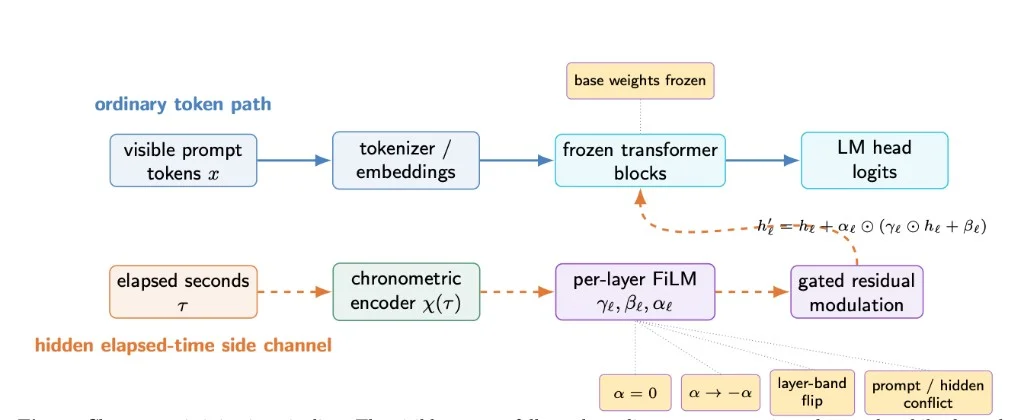
 Zenodo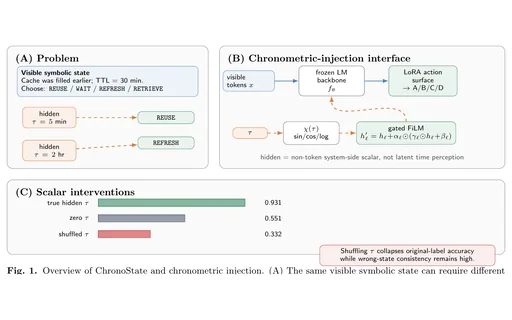
Under review
Engram Injection: Learning Temporal Validity in Parametric Language-Model Memory
S. Siavoshian, O. Ramadan, A. K. Saeed, A. M. E.-A. Diab, B. M. Rodriguez
PALM Workshop at NeurIPS 2026
Continuous Stateful Intelligence: Persistent Memory and Lifecycle Control for Long-Running Language Models
S. Siavoshian, O. Ramadan, A. K. Saeed, A. M. E.-A. Diab, B. M. Rodriguez
ICLR 2027
Before that, I built Virex, a tweet-virality model trained on 250K+ scraped tweets with a gradient-boosted mixture of experts.