Engram Injection
Engram Injection: A Study of Temporal Validity in Parametric Language-Model Memory
First author, with Johns Hopkins. Preprint on arXiv:2610.15882, DOI 10.48550/arXiv.2610.15882. PDF. Other papers.
Abstract
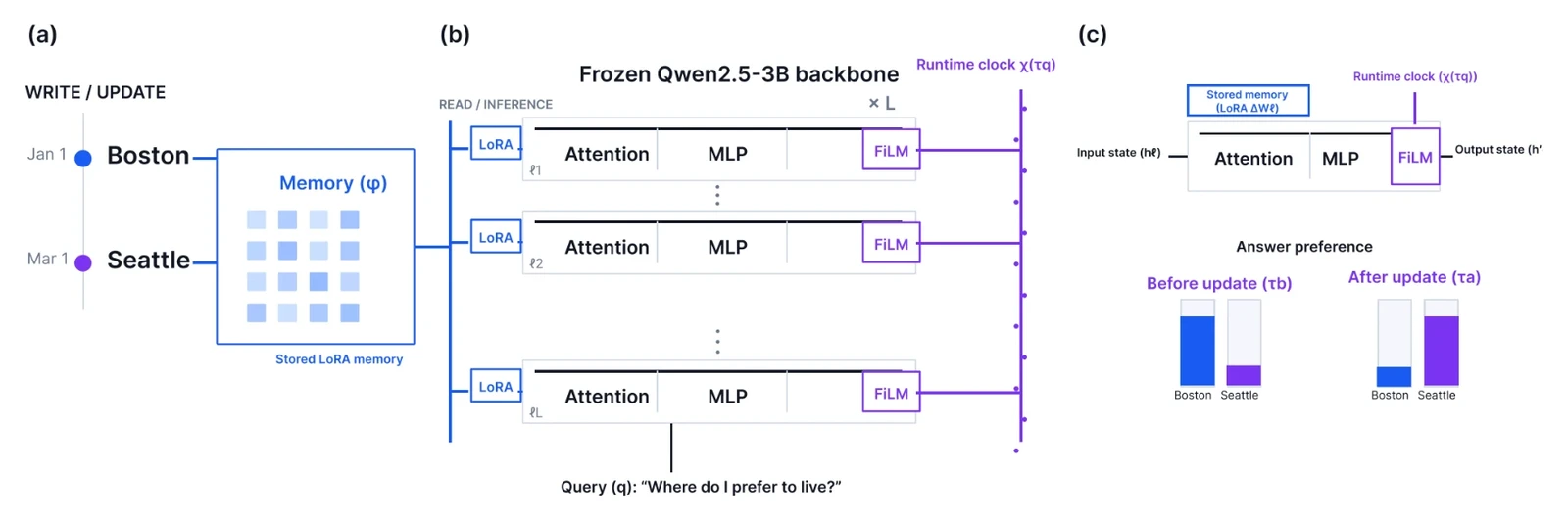
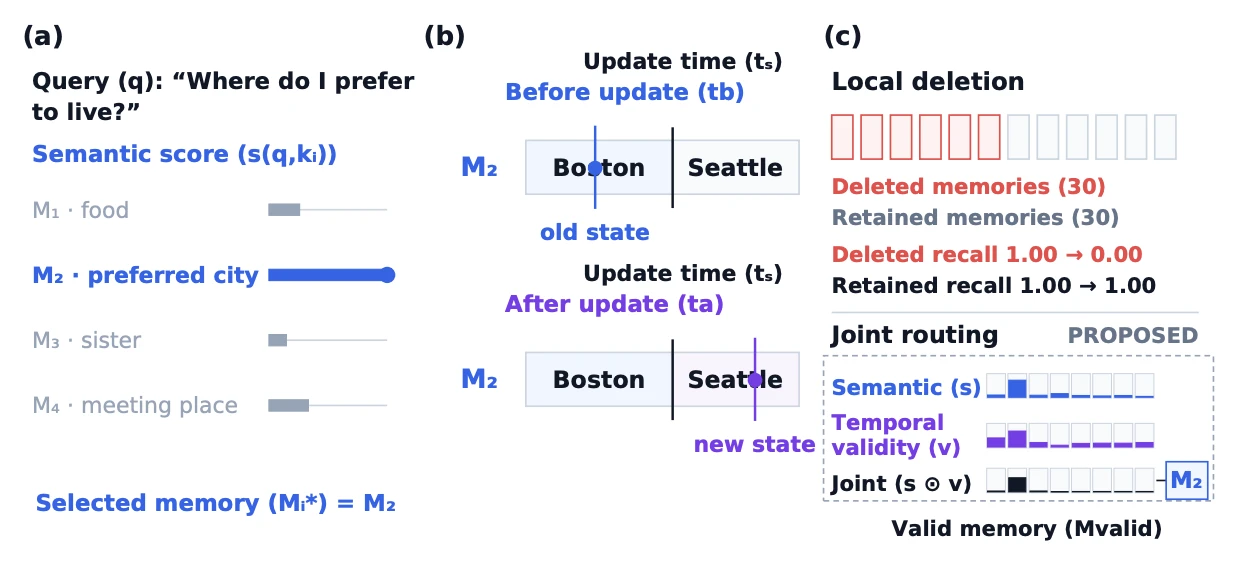
A stored fact may stop being valid when a user changes a preference or an event replaces an earlier one. We study whether a language model can learn these changes in its parameters and answer correctly from only a question and the current time. Engram Injection stores facts in LoRA adapters and supplies the clock through FiLM conditioning on a frozen Qwen2.5-3B-Instruct model. We compare it with additive clock conditioning, prompting with the full dated history, and retrieving four dated records. We train six matched adapters across three seeds after fixing a sampler that could admit test-age examples into training. The training audit reports no such examples among 127,760 evaluated training inputs. On 62 pairs of questions asked before and after an update, at an elapsed age of seven days excluded from training, both adapter methods answer zero pairs correctly under the primary blinded assistant review with order code 1 held fixed. Full-history prompting answers 59/62 pairs correctly, and retrieval answers 62/62. Separate experiments show that adapters can store facts and that removable memory units can support local deletion. Combining fact selection with time-based version selection remains unsuccessful. These results separate learning a fact from learning when to use it.
Cite
Siavoshian, S., Ramadan, O., Saeed, A. K., Johnson, B. A., & Rodriguez, B. M. (2026). Engram Injection: A study of temporal validity in parametric language-model memory (arXiv:2610.15882). arXiv. https://doi.org/10.48550/arXiv.2610.15882
@misc{siavoshian2026engram,
  title         = {{Engram Injection}: A Study of Temporal Validity in Parametric Language-Model Memory},
  author        = {Siavoshian, Sam and Ramadan, Omar and Saeed, Amir Kashif and Johnson, Benjamin A. and Rodriguez, Benjamin M.},
  year          = {2026},
  eprint        = {2610.15882},
  archivePrefix = {arXiv},
  primaryClass  = {cs.AI},
  doi           = {10.48550/arXiv.2610.15882},
  url           = {https://arxiv.org/abs/2610.15882}
}